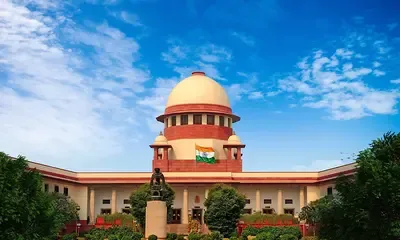
New Delhi: Deprecating the recent practice of courts enhancing compensation to victims in grave offences and reducing the sentence of the accused "capriciously and mechanically", the Supreme Court on Tuesday termed it as a "dangerous" trend which is sending a wrong message to society that offenders can absolve themselves by merely paying money.
A bench of Justices Rajesh Bindal and Vijay Bishnoi said the objective of punishment is to create an effective deterrence so that the same crime or actions are prevented and mitigated in future.
It said the consideration to be kept in mind while awarding punishment is to ensure that the punishment should not be very harsh but at the same time, it should also not be too lenient so as to undermine its deterrent effect.
"The misplaced understanding of various courts in treating compensation as a substitute for sentence is both a matter of concern and a practice which should be condemned. We have observed a trend amongst various high courts wherein the sentences awarded to the accused persons by the trial court are reduced capriciously and mechanically, without any visible application of judicial mind," the bench said.
It added, "The practice of enhancing the compensation payable to the victim and reducing the sentence, especially in cases of grave offence, is dangerous as it might send a wrong message to society that the offenders/ accused persons can absolve themselves from their liability by merely paying a monetary consideration." The top court made the remarks in a case where the Madurai bench of the Madras High Court reduced the sentence of three years awarded to two men for stabbing and causing grievous injury to a fellow village man to the period already undergone in jail and enhanced the compensation of Rs 5,000 to Rs 50,000 each payable to the victim.
The bench said it is constrained to observe that the high court acted in complete defiance of the law and created a travesty of the established criminal jurisprudence in arriving at its conclusion.
"The high court in the impugned judgment noted that more than ten-and-a-half years had elapsed since the incident and that the victim had been murdered by some other persons a few years later. Based on these aspects, the high court modified the sentence awarded to the accused persons.
"Apart from the above, the High Court failed to reason out the circumstances, acting on which, it reduced the sentence for such a heinous offence and thereby, erred in not applying its judicial mind to accurately decide the sentence," the top court said.
The Supreme Court said considering the gravity of the situation, it has culled out certain basic factors which are to be kept in mind by the courts while dealing with the imposition of sentence in line with the view taken by it in the earlier cases.
Among the factors to be considered by the courts while sentencing the accused are: proportionality between the crime committed and the punishment awarded, due consideration to facts and circumstances, impact on society and the aggravating and mitigating factors.
The Supreme Court said that retribution is not the ultimate aim of the Indian criminal justice system; rather, it hinges on principles of reformation and restitution.
"The criminal justice system aims to achieve the twin objectives of creating a deterrence against crime and also providing an opportunity for reformation to the offender. Due consideration has also been provided by our legal system to the rights of the victim, who essentially are the first sufferers of the crime," it said, adding that Section 395 of the Bharatiya Nagarik Suraksha Sanhita (BNSS) recognises the loss caused to the victim and accordingly provides for granting monetary compensation to the victim.
"The said provision of victim compensation is not an alternative to the sentence or punishment imposed; however, the compensation is just an addition to the sentence already awarded," it underscored.
The top court said the rationale behind victim compensation is to rehabilitate the victim for the loss and injury caused to them as a direct consequence of the crime or offence and not to exonerate the offender/ accused from their culpability.
It set aside the high court's order and upheld the trial court's order sentencing the accused for three years.
"We direct that the private respondents must surrender before the trial court within four weeks from today and shall serve the remaining part of the sentence awarded to them. The trial court shall ensure that they serve the remaining sentence, after adjustment of the period already undergone by them," it ordered.
Contact to : xlf550402@gmail.com
Copyright © boyuanhulian 2020 - 2023. All Right Reserved.