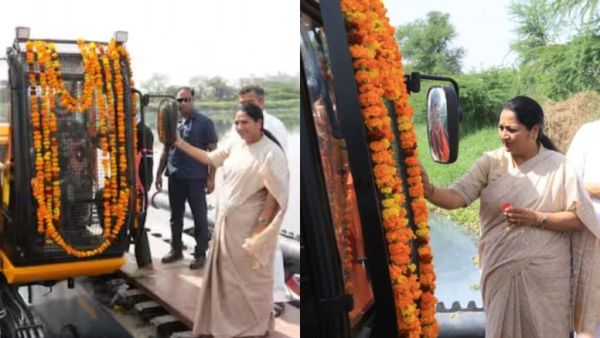
Chief Minister Rekha Gupta started the cleaning work of Najafgarh Drain and Pankha Road Drain by flagging off the state-of-the-art amphibious excavator machines on Badusarai Bridge. The deployment of modern long-boom and short-boom machines will speed up the work of removing silt, garbage and water hyacinth and will increase the water carrying capacity of the drains. This will help in reducing the problem of waterlogging during monsoon and will also strengthen the larger goal of cleaning Yamuna.
Now Najafgarh drain will be cleaned faster
The Najafgarh drain is the largest drain in Delhi and carries about 75 percent of the silt in the city’s drainage system. It is estimated that more than 10 million metric tons of silt has accumulated in the Najafgarh drain over the years. The newly deployed floating machines can reach the middle of the drain and directly remove accumulated silt and silt, significantly speeding up the cleaning process. Four new amphibious machines were flagged off, while one machine had already been delivered. The remaining machines will also be handed over to the department soon.
Features of amphibious machine
These machines have been deployed by the Irrigation and Flood Control (I&FC) department at several key locations including Badusarai Bridge, Kakrola, Dwarka and Uttam Nagar. The cost of the short-boom amphibious machine is approximately Rs 1.27 crore. It has approximately 6 meter long boom, bucket capacity of 0.20 cubic meter, 65 HP engine and 2.25 cubic meter waste bin. It can work even in narrow drains of about 5 meters wide.
The machine can work in marshy and waterlogged areas
The cost of the long-boom amphibious machine is approximately Rs 3.15 crore. It has a 15 meter long boom, bucket capacity of 0.50 cubic meter and 135 HP engine. It can operate up to a depth of approximately 9 meters and works effectively in dry, marshy and waterlogged conditions.
Follow the LALLURAM.COM MP channel on WhatsApp