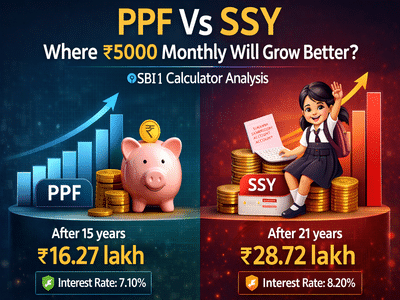
PPF vs SSY Investment 2026: If you are planning long-term savings, two government-backed schemes—Public Provident Fund (PPF) and Sukanya Samriddhi Yojana (SSY)—are among the most popular choices. But if you invest ₹5,000 every month, which scheme will help you build a bigger fund? Let’s break it down using real calculations.
Interest Rates Remain Unchanged for Q1 FY 2026–27The government has kept interest rates unchanged for small savings schemes for the April–June 2026 quarter. This means:
- PPF Interest Rate: 7.10% per annum
- SSY Interest Rate: 8.20% per annum
These rates continue from the previous quarter, as confirmed by the Finance Ministry.
Investment Scenario: ₹5,000 Per MonthIf you invest ₹5,000 every month:
- Annual investment = ₹60,000
- Total investment in 15 years = ₹9,00,000
Now let’s compare how much wealth each scheme can generate.
PPF Calculation: Steady Growth Over 15 YearsUnder the Public Provident Fund:
- Investment Duration: 15 years
- Total Investment: ₹9,00,000
- Interest Rate: 7.10%
- Maturity Amount: ₹16,27,284
- Interest Earned: ₹7,27,284
PPF offers stable and tax-free returns, making it a preferred choice for conservative investors. Additionally, after 15 years, the account can be extended in blocks of 5 years for continued growth.
SSY Calculation: Higher Returns Over Longer PeriodUnder the Sukanya Samriddhi Yojana:
- Investment Duration: 15 years
- Maturity Period: 21 years
- Total Investment: ₹9,00,000
- Interest Rate: 8.20%
- Maturity Amount: ₹28,72,848
- Interest Earned: ₹19,72,848
In SSY, even after you stop investing after 15 years, the money continues to earn interest for another 6 years, significantly boosting the final corpus.
Key Difference Between PPF and SSY| Interest Rate | 7.10% | 8.20% |
| Maturity Period | 15 years | 21 years |
| Investment Duration | 15 years | 15 years |
| Returns | Moderate | Higher |
| Tax Benefit | Yes | Yes |
| Eligibility | Anyone | Only for girl child |
Based on the above calculations:
- PPF: ₹16.27 lakh after 15 years
- SSY: ₹28.72 lakh after 21 years
Clearly, SSY generates a significantly larger corpus due to:
- Higher interest rate
- Longer compounding period
However, SSY is limited to parents or guardians investing for a girl child, whereas PPF is open to all individuals.
Which One Should You Choose?Your choice depends on your financial goals:
- Choose PPF if:
- You want flexibility
- You’re planning retirement savings
- You prefer a shorter lock-in
- Choose SSY if:
- You are saving for a girl child’s future
- You want higher long-term returns
- You can stay invested for 21 years
Both PPF and SSY are excellent long-term investment options backed by the government. While PPF offers flexibility and stability, SSY stands out for delivering higher returns over a longer period.
If eligible, SSY can help you build a significantly larger fund with the same monthly investment, making it a powerful tool for future financial planning.
Contact to : xlf550402@gmail.com
Copyright © boyuanhulian 2020 - 2023. All Right Reserved.