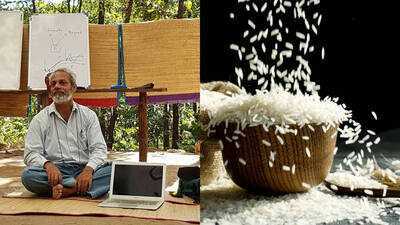
In a part of Odisha where agriculture is often reduced to yield, input costs and market price, Debal Deb built his life around a quieter kind of value: memory. A grain handed from one farmer to another became, in his hands, a record of climate, taste, survival and inheritance. Over time, that modest exchange grew into a seed bank and a farm laboratory, and the number of rice varieties he has safeguarded rose far beyond 900. Today, the work tied to his name spans more than 1,400 indigenous rice landraces, each one a tiny archive of rural India. Scroll down to read more...
How the mission began
Debal Deb did not begin with a polished conservation plan. According to interviews and profiles from 2022 to 2024, he began conserving indigenous rice varieties in the 1990s after noticing how quickly they were losing ground to Green Revolution crops. That shift mattered because the old landraces were not simply old-fashioned; many were adapted to local conditions, and their disappearance meant a loss of genetic diversity at the very moment farming was becoming more vulnerable to climate stress.
He founded Vrihi in 1997 as a non-governmental rice seed bank for farmers, and later built Basudha in Odisha as a farm where those seeds could be grown in situ rather than stored as static museum pieces. Vrihi describes itself as the first non-governmental rice seed bank for farmers and says it was created in response to the failure of ex situ seed banks to stop genetic erosion. That detail is important: Deb’s project is not about freezing seeds in time, but keeping them alive in fields, where they can keep adapting.
Why old rice mattered so much
The scale of the loss is what gives Deb’s work urgency. In a 2022 interview, he said India once had about 110,000 rice varieties, and that nearly 90 percent of the genetic diversity had disappeared from farmers’ fields. He has argued that these landraces evolved over centuries with built-in resilience to floods, droughts, pests and disease, exactly the qualities farmers need in an era of unstable weather. In other words, what looked outdated on paper often proved more durable in the field.
That is why Deb’s conservation work has drawn notice beyond environmental circles. The World Economic Forum described him as the “Seed Warrior” in 2019 and noted that his seed bank housed more than 1,410 endangered varieties. A 2024 profile said he safeguarded 1,442 rice varieties between Basudha and Vrihi, all passed to him by farmers and all adapted to local conditions. Another 2022 interview put the figure at nearly 1,500. The exact count shifts as the collection grows, but the direction is unmistakable.
A bank that behaves like a living network
What makes Deb’s model different is the way seeds move. Vrihi says its model is rooted in non-commercial exchange, and the WEF profile reported that seeds are shared with farmers on the condition that they cultivate them and return part of the harvest to the community. IndiaSpend similarly reported that Deb has shared seeds with nearly 8,000 farmers for free. This is conservation with circulation built in: the rice is not only saved, it is redistributed so that villages can keep growing it.
That living system also explains why Basudha matters so much. It is not a decorative research plot or a private collector’s reserve. It is a working farm in Rayagada district where rare rice varieties are regenerated under real growing conditions. Vrihi says the farm began regular in situ cultivation in 2001, and recent profiles describe it as a small but highly active centre for ecological farming, farmer exchange and seed revival.
The quiet politics of preserving a grain
Debal Deb’s work also carries a sharper argument about agriculture itself. He has repeatedly criticised the idea that modernity must mean uniformity, warning that dependence on a narrow set of high-yield varieties leaves farmers exposed to debt, fertiliser dependency and climate risk. The logic is simple but unsettling: when farming systems become too uniform, they become fragile. His rice collection, by contrast, is an argument for diversity as insurance.
The result is a body of work that sits at the intersection of ecology, agriculture and culture. Some varieties are prized for flood tolerance, some for drought tolerance, some for nutrition, and some for the fact that they survive in places where modern cultivars struggle. Together, they form a record of what Indian farming knew long before climate resilience became a policy phrase.
What his work leaves behind
Debal Deb’s mission is persuasive because it is practical. He did not just preserve seeds for the sake of nostalgia; he built a system in which seeds could keep working for farmers. That is the deeper lesson of his life’s work. Biodiversity is not an abstract environmental virtue. In the right hands, it becomes a tool for survival, a way of keeping food systems flexible when weather, markets and policy stop behaving predictably. In that sense, every rice variety he saved is more than a grain. It is a possibility.
Contact to : xlf550402@gmail.com
Copyright © boyuanhulian 2020 - 2023. All Right Reserved.