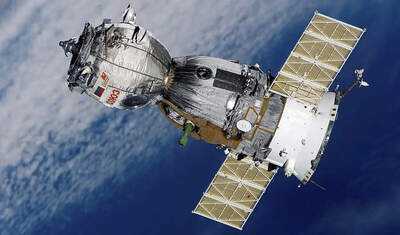
While conflicts on Earth are frequently reported, the situation in space has also become alarming. The risk of collisions in the cosmos is escalating rapidly, transforming into a frightening reality. Current data indicates that the orbital pathways around Earth are now under significant pressure from high-speed traffic, forcing Indian satellites to constantly alter their trajectories to avoid potential collisions.
According to projections for 2025, over 150,000 warnings regarding close encounters with Indian space assets are expected, highlighting the severity of the situation.
Alarming Statistics from Space Situational Reports
The Indian Space Situational Awareness Report for 2025 paints a dire picture of this crisis. Globally, approximately 160,000 warnings have been issued, many generated by U.S. space operations centers. Each warning signifies a potential collision, indicating that space is rapidly becoming congested and the risks are on the rise. The pressure behind record-breaking launches is now becoming evident.
Challenges Posed by Satellite Congestion
The root of the problem lies in the overwhelming number of satellite launches. The situation has worsened with over a hundred objects being sent into space in a single day, reducing reaction times and complicating monitoring efforts. This has become a significant challenge for the Indian Space Research Organisation (ISRO). In 2025, Indian missions conducted a total of eighteen collision avoidance maneuvers, with fourteen in low Earth orbit and four in geostationary orbit. Each maneuver involved thorough risk assessments to eliminate the possibility of collisions with nearby objects.
Operational Adjustments to Mitigate Risks
Moreover, adjustments were necessary for a total of 82 operational plans to prevent potential collisions post-maneuver. This figure is particularly concerning for low Earth orbit satellites, while two adjustments were also made for geostationary satellites. This indicates that every action in space must now be taken with extreme caution, as even a minor error could lead to catastrophic outcomes.
Deep Space Missions Also Affected
Deep space missions are not immune to this crisis either. The Chandrayaan-2 orbiter had to change its orbit sixteen times and alter its plans twice to avoid potential threats. This underscores the increasing difficulty of maintaining safety in space.
Global Launch Statistics and Implications
On a global scale, the situation is becoming even more explosive. In 2025, there were a total of 315 successful launches, resulting in 4,651 objects being placed into orbit, a significant increase compared to previous years. Out of these, 4,198 are active satellites. Although 1,911 objects have re-entered the atmosphere, the overall number continues to rise.
A Critical Turning Point for Space Safety
The threat has now reached a critical juncture. In the coming decade, the number of active satellites could surpass that of space debris. This implies that fast-moving objects in space will navigate through increasingly narrow paths, significantly heightening the risk of collisions. This scenario points to an explosive tipping point where even a slight lapse in control and coordination could lead to disastrous consequences.
The Need for Global Coordination
Clearly, space is no longer a tranquil domain of science; it is evolving into a battleground where nations are vying to expand their presence. However, the consequences of this reckless race could be perilous. Without stringent regulations and global coordination implemented promptly, space collisions could pose new challenges for humanity in the years to come.
Contact to : xlf550402@gmail.com
Copyright © boyuanhulian 2020 - 2023. All Right Reserved.