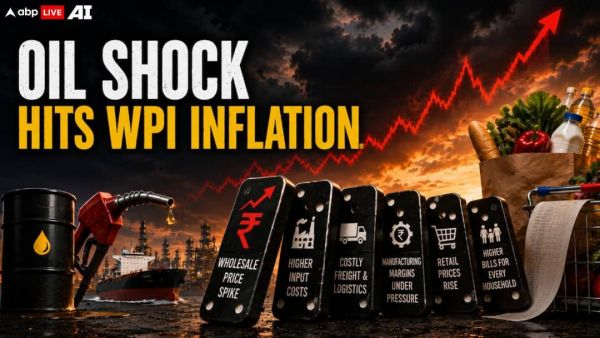
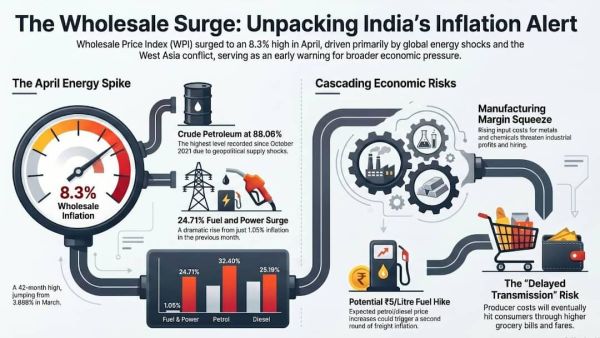
WPI Inflation Data: Wholesale inflation in April surged to 8.3 per cent, the highest level seen in 42 months, as the ongoing West Asia conflict sent global energy markets into turmoil and sharply raised the cost of crude imports. The latest Wholesale Price Index (WPI) reading marks a dramatic jump from 3.88 per cent in March and just 0.85 per cent a year ago.
The numbers may look technical on paper, but economists say this spike carries consequences that could eventually touch everything from grocery bills and cab fares to EMI planning and job creation.
Why This Inflation Spike Is Different From Earlier Ones
India has seen inflationary phases before. But this one is structurally different because it is being driven by imported energy costs rather than domestic consumption demand.
The biggest trigger has been the disruption in crude oil supply chains following the West Asia conflict and the blockade of the Strait of Hormuz, one of the world’s most critical oil transit chokepoints. India imports nearly 85 per cent of its crude oil requirement, making the country extremely vulnerable to geopolitical supply shocks. That vulnerability is now visible in the data.
Inflation in fuel and power skyrocketed to 24.71 per cent in April from just 1.05 per cent in March. Crude petroleum inflation hit 88.06 per cent, the highest since October 2021. Petrol inflation jumped to 32.40 per cent, while diesel inflation surged to 25.19 per cent. Even LPG inflation swung sharply positive to 10.92 per cent after remaining in negative territory the previous month.
According to global brokerage Barclays, the month-on-month increase in WPI inflation was the highest ever recorded in the current series.
The Commerce and Industry Ministry said, “Positive rate of inflation in April 2026 is primarily due to an increase in prices of mineral oils, crude petroleum & natural gas, basic metals, other manufacturing and non-food articles, etc.”
The Real Risk Lies Ahead, Not Behind
Unlike retail inflation, wholesale inflation captures price pressures at the producer and industrial level. That means manufacturers, transporters, logistics operators, and factories are already paying more for energy and raw materials. Those higher costs eventually trickle down to consumers.
This is why analysts believe the current WPI surge may be an early warning signal for broader inflation ahead.
India Ratings & Research Director Megha Arora warned that wholesale inflation could climb further to 9 per cent in May. “WPI is expected to be higher than the CPI on account of higher weight of fuels in the index, as well as delayed transmission of high crude price to consumers, as the government and the oil marketing companies absorbed most of it until now,” Arora said. That “delayed transmission” is crucial.
The government has so far resisted raising petrol, diesel, and household LPG prices despite a roughly 50 per cent rise in global crude oil prices. Instead, oil marketing companies and the government have absorbed much of the burden to prevent an immediate hit on consumers.
But economists say such shielding cannot continue indefinitely. Barclays expects a Rs 5 per litre increase in petrol and diesel prices in May if crude prices remain elevated.
If that happens, India could witness a second-round inflation effect, where transportation costs rise, freight becomes more expensive, and companies begin passing higher operating costs to consumers.
Manufacturing Sector Faces Margin Squeeze
The inflation surge is also exposing pressure points inside India’s industrial economy.
Core WPI inflation rose to 5 per cent year-on-year, led by manufactured products including metals, chemicals, and textiles. Inflation in manufactured products climbed to 4.62 per cent from 3.39 per cent in March.
This matters because manufacturing sits at the centre of India’s growth ambitions. Rising input costs can reduce company margins, delay expansion plans, and weaken hiring momentum.
In simpler terms, companies are entering a difficult balancing act. Raise prices too much, and consumer demand weakens. Absorb costs internally, and profits shrink. Either way, economic growth risks slowing.
Why Indian Households Cannot Ignore WPI Inflation
Many Indians usually track retail inflation or CPI because that directly affects kitchen budgets. WPI often remains an obscure economic indicator discussed mainly in policy circles. But this time, wholesale inflation could become the first domino in a larger chain reaction.
Higher fuel costs influence almost every sector of the economy. Truck freight becomes expensive. Airline fuel costs rise. Food transportation becomes costlier. Factories pay more for power. Construction materials become expensive.=Eventually, those increases show up in everyday life.
There is also another risk looming in the background: weather.
Economists warn that a potential El Nino effect could disrupt rainfall patterns and food output later in the year. If food inflation rises alongside energy inflation, policymakers could face a much more difficult situation.
For now, the Reserve Bank of India may still treat the current inflation spike as a supply-side shock rather than a demand-driven overheating cycle. Barclays said it expects the Monetary Policy Committee to maintain its current stance through the rest of 2026.
But if crude prices remain elevated and retail inflation starts climbing sharply, India’s economic balancing act could become far more complicated in the months ahead.
(With inputs from PTI)
Contact to : xlf550402@gmail.com
Copyright © boyuanhulian 2020 - 2023. All Right Reserved.