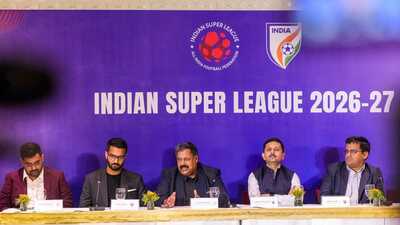
New Delhi: The future of the Indian Super League has received clarity after the All India Football Federation and league clubs reached an agreement that will allow a full-fledged competition from the 2026-27 season.
Under the new arrangement, ISL clubs will receive the commercial rights of the league for four years, although they will have the option to exit the agreement after two years. The move ends months of uncertainty after the previous Master Rights Agreement between AIFF and its commercial partners ended in December last year.
AIFF deputy secretary-general M Satyanarayan confirmed that the federation will continue handling administrative and regulatory responsibilities while clubs will take charge of the commercial side of the competition.
“We have agreed on certain things with the clubs. We are giving them the commercial rights of the ISL and as usual the AIFF will hold on to the administrative and all the important aspects of running the league,” Satyanarayan said.
New club-led structure for ISLA Special Purpose Vehicle (SPV) will be created to manage the league with clubs contributing Rs 1.1 crore each in administrative fees to support AIFF’s regulatory work including refereeing, legal matters, integrity measures and anti-doping programmes.
The federation will receive 10 per cent of the ISL’s net profit while the remaining 90 per cent will go to the clubs. The teams will also appoint a professional management group to oversee daily operations and future commercial planning.
FC Goa CEO Ravi Puskur said the clubs are committed to building a sustainable league and improving its position in Asian football. He added that the new model will allow clubs to have a greater role in shaping the competition.
The 2026-27 ISL is scheduled to begin on 4 September with clubs expected to confirm their participation within 15 days after receiving official communication from AIFF.
OCI player rule made optionalThe AIFF also clarified its position on Overseas Citizen of India (OCI) players, confirming that signing them will not be compulsory for ISL clubs.
Earlier, the federation had suggested that teams could include one OCI player alongside three foreign players in their starting XI. However, Satyanarayan explained that clubs will have the freedom to decide their squad structure.
The requirement for clubs to keep an Indian striker on the field for the entire 90 minutes has also been made optional. AIFF said clubs are aware of India’s shortage of quality strikers and encouraged them to focus on developing players in that position.
With the new club-led approach, Indian football enters a new phase. Both AIFF and ISL teams believe the model can bring financial stability and help the league grow further but the success of the system will depend on careful planning and long-term investment.
Contact to : xlf550402@gmail.com
Copyright © boyuanhulian 2020 - 2023. All Right Reserved.