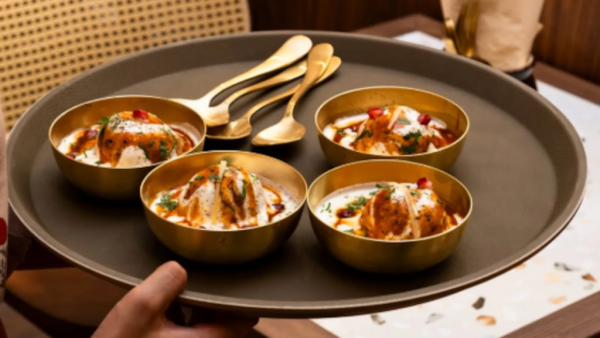
Haldiram’s has officially opened its doors in London, bringing one of India’s most recognizable food brands to the UK. Social media is flooded with videos of NRIs flocking to the newly opened Haldiram’s to try chole bhature, chaat and other desi delicacies. Along with the crowds, the menu prices are also turning heads. A plate of Pani Puri that costs Rs 75 at Haldiram’s in Delhi is priced at 6.50 pounds (approx. Rs 830) in London. Pav Bhaji, an iconic Mumbai street food, costs 9.90 pounds (approx. Rs 1270), compared to Rs 198 in Delhi. Even a Garlic Naan is priced at 5 pounds (approx. Rs 640), almost 7 times its Delhi price (Rs 95).
While higher operating costs, import costs and local taxes naturally contribute to overseas pricing, the comparison also highlights how Haldiram’s has repositioned itself in the UK, not as an everyday, value-driven restaurant, but as a premium Indian casual dining destination.
We compared the menus of Haldiram’s London and Haldiram’s Delhi to see how they stack up. Beyond the striking price differences, the UK outlet also features a smaller, more curated menu, detailed dish descriptions for international diners and a noticeably different dining experience.
Here’s how the prices compare, based on an exchange rate of approximately 1 pound = Rs 128.
Note: Currency conversions are approximate and based on an exchange rate of 1 pound = Rs 128. Prices are subject to change.
Haldiram’s Price Comparison: Delhi vs London
- Pani Puri: London (6.50 pounds / approx. Rs 830) vs Delhi (Rs 75) – 11.07 times more expensive in London.
- Papdi Chaat: London (7.50 pounds / approx. Rs 960) vs Delhi (Rs 160) – 6 times more expensive in London.
- Special Dahi Bhalla: London (7.50 pounds / approx. Rs 960) vs Delhi (Rs 160) – 6 times more expensive in London.
- Aloo Tikki: London (7.50 pounds / approx. Rs 960) vs Delhi (Rs 124) – 7.74 times more expensive in London.
- Aloo Tikki Chole Chaat: London (7.50 pounds / approx. Rs 960) vs Delhi (Rs 170) – 5.65 times more expensive in London.
- Bombay Vada Pao: London (6.50 pounds / approx. Rs 830) vs. Delhi Jumbo Vada Pao (Rs 54) – 15.37 times more expensive in London.
- Quantity of Kulcha: London (9.90 pounds / approx. Rs 1,267) vs Delhi (Rs 165) – 7.68 times more expensive in London.
- Raj Kachori: London (9.90 pounds / approx. Rs 1,267) vs Delhi (Rs 174) – 7.28 times more expensive in London.
- Bedmi Puri Sabji Halwa: London (10.90 pounds / approx. Rs 1,395) vs Delhi (Rs 194) – 7.19 times more expensive in London.
- Chole Bhature: London (11.50 pounds / approx. Rs 1,475) vs Delhi (Rs 198) – 7.45 times more expensive in London.
- Pav Bhaji: London (9.90 pounds / approx. Rs 1,267) vs Delhi (Rs 198) – 6.4 times more expensive in London.
- Rajma with Rice: London (10.50 pounds / approx. Rs 1,344) vs Delhi (Rs 140) – 9.6 times more expensive in London.
- Dal Makhani with Rice: London (10.50 pounds / approx. Rs 1,344) vs Delhi (Rs 190) – 7.07 times more expensive in London.
- Dal Tadka with Rice: London (10.50 pounds / approx. Rs 1,344) vs Delhi (Rs 341) – 3.94 times more expensive in London.
- Garlic Naan: London (5 pounds / approx. Rs 640) vs Delhi (Rs 95) – 6.74 times more expensive in London.
- Butter Roti: London (4 pounds / approx. Rs 512) vs Delhi (Rs 59) – 8.68 times more expensive in London.
- Stuffed Tandoori Aloo Parantha: London (6.50 pounds / approx. Rs 832) vs Delhi (Rs 110) – 7.56 times more expensive in London.
- Stuffed Tandoori Paneer Parantha: London (6.50 pounds / approx. Rs 832) vs Delhi (Rs 136) – 6.12 times more expensive in London.
- Stuffed Tandoori Aloo Pyaaz Parantha: London (6.50 pounds / approx. Rs 832) vs Delhi (Rs 122) – 6.82 times more expensive in London.
- Sweet Lassi: London (6 pounds / approx. Rs 768) vs Delhi (Rs 110) – 6.98 times more expensive in London.
- Almond Milk: London (6.50 pounds / approx. Rs 832) vs Delhi (Rs 110) – 7.56 times more expensive in London.
- Masala Chaas: London (5 pounds / approx. Rs 640) vs Delhi (Rs 81) – 7.9 times more expensive in London.
- Karak Chai: London (3.50 pounds / approx. Rs 448) vs Delhi Live Masala Tea (Rs 65) – 6.89 times more expensive in London.
Key takeaways:
- Most expensive relative to Delhi: Bombay Vada Pao (15.37x), followed by Pani Puri (11.07x) and Rajma with Rice (9.60x).
- Least difference: Dal Tadka with Rice (3.94x), Aloo Tikki Chole Chaat (5.65x), and Papdi Chaat/Special Dahi Bhalla (6x).
- Most items are priced between 6x and 8x higher in London than in Delhi.
Beyond The Prices: How The London Menu Differs
The menu differences go far beyond pricing. Haldiram’s has thoughtfully adapted its offering for an international audience rather than replicating its Indian restaurants.
Limited Items On London Menu
One of the first things that stands out is the menu size. While Haldiram’s Delhi offers more than 80 dishes spanning North Indian, South Indian, Chinese, Continental, sandwiches, sweets and beverages, the London outlet features around 40 carefully selected items.
Entire sections like South Indian favourites, Chinese dishes, sandwiches and desserts have been omitted. Instead, the focus is firmly on iconic North Indian street food and comfort dishes that are likely to appeal to both NRIs and customers trying Indian cuisine for the first time.
Detailed description of dishes
Unlike the Delhi menu, which simply lists dish names, almost every item on the London menu includes a detailed description explaining what diners can expect. Everyday favorites like Pani Puri, Rajma with Rice and Bombay Vada Pao are described in a way that makes them more approachable for people unfamiliar with Indian cuisine while also giving them a more premium feel.
Many familiar dishes have also been given a more refined presentation. Instead of simply listing “Pani Puri”, the London menu describes it as “crisp hollow puffs filled with potatoes and herb-infused spicy or sweet water.” Vada Pao becomes a “spiced potato cutlet in a buttered bun with garlic-peanut crumble and herb chutney”, while Raj Kachori is described as “a feast in an oversized handcrafted crisp shell overflowing with layers of flavor and texture.”
Wraps And Beverages
The UK outlet also introduces grab-and-go options like Paneer Tikka Wrap and Tandoori Soya Chaap Wrap, neither of which appears on the Delhi menu. At the same time, the drinks selection has been streamlined, focusing on lassis, chaas, Badam Milk, Karak Chai and espresso-based coffees.
Overall, the comparison makes one thing clear: Haldiram’s hasn’t simply exported its Indian restaurant overseas. Instead, it has curated a smaller menu, elevated the presentation of familiar dishes and positioned itself as a premium Indian dining destination for a global audience. The dramatic price differences, ranging from six to over 15 times those in Delhi, underscore just how differently the brand is positioned outside India.
Contact to : xlf550402@gmail.com
Copyright © boyuanhulian 2020 - 2023. All Right Reserved.