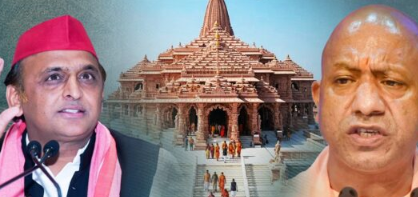
When a political challenge arose from the land of Ayodhya, the city of Lord Ram, Chief Minister Yogi Adityanath was quick to respond. Samajwadi Party President Akhilesh Yadav said that if Yogi Adityanath is so confident in his work and popularity, he should contest the elections from Ayodhya. Two days later, Yogi retaliated. He roared, “Akhilesh should file his nomination from Ayodhya himself. Why should the contest be based on supporters or small-time politicians? He should come to Ayodhya and face each other and fight.”
The SP chief was probably waiting for this. In response, Akhilesh reminded the BJP of its defeat in the 2024 Faizabad Lok Sabha elections and expressed confidence in his young candidate. Now the question is: is this merely a verbal battle, or is a larger political game being laid regarding Ayodhya before the 2027 assembly elections? Behind this challenge lie the electoral results from 2012 to 2024, the changed political discourse after the Ram Temple, and the differing social equations of the BJP and the SP.
What challenge did Akhilesh give earlier?
On October 8, 2026, Akhilesh Yadav attended a Srimad Bhagwat Katha (sacred story) held at the residence of Samajwadi Party candidate Tejnarayan Pandey, also known as Pawan Pandey, in Ayodhya. During this, he challenged Chief Minister Yogi Adityanath to contest the Ayodhya assembly seat. Akhilesh argued that if the Chief Minister was confident in his work and popularity, he should contest from Ayodhya. He claimed that after the SP candidate was announced, the BJP was conducting surveys and was having trouble selecting a candidate. Yogi Adityanath did not even have the authority to choose a candidate.
It would be incomplete to consider the two leaders’ statements merely a political spat. The Uttar Pradesh Assembly has a total of 403 seats, and the next assembly elections are scheduled for 2027. In this context, challenging Chief Minister Yogi from Ayodhya is a way to turn a local constituency into a statewide debate. The Samajwadi Party had already announced Pawan Pandey as its candidate. Akhilesh’s statement increased the buzz around his candidate and challenged the BJP’s most prominent state-level figure to contest from the very constituency that the BJP presents as a key symbol of the Ram Temple and Hindutva politics.
What do the old results of Ayodhya tell us?
The electoral history of the Ayodhya assembly seat shows that the contest between the BJP and the Samajwadi Party has been volatile here in the past. In the 2012 assembly elections, the Samajwadi Party’s Pawan Pandey defeated the BJP’s Lallu Singh by 5,405 votes. In 2017, the BJP’s Ved Prakash Gupta defeated Pawan Pandey by 50,440 votes. Ved Prakash Gupta also won in 2022, but this time the margin of victory was reduced to 19,990 votes.
The SP’s victory in 2012, the BJP’s significant lead in 2017, and the narrowing margin of victory in 2022 help us understand the electoral history of Ayodhya. This certainly shows that the nature of the contest between the two parties has changed across elections, but the outcome of 2027 cannot be determined solely by the margin of victory.
Assembly election figures
In the 2024 Faizabad Lok Sabha election, Samajwadi Party candidate Awadhesh Prasad received 554,289 votes, while Bharatiya Janata Party candidate Lallu Singh received 499,722 votes. Sachidanand Pandey of the Bahujan Samaj Party received 46,407 votes. Awadhesh Prasad defeated Lallu Singh by 54,567 votes. This result, coming just months after the consecration of the Ram Temple, brought the politics of Faizabad and Ayodhya to the national spotlight.
Pawan Pandey has previously served as an MLA from Ayodhya and lost to Ved Prakash Gupta of the BJP in 2017 and 2022. Now, the SP has renominated him as its candidate. Therefore, Akhilesh’s challenge cannot be seen separately from the fight against his declared candidate.
Why did Yogi ask to fight face to face?
On October 10, 2026, during a public meeting in Balrampur, Yogi Adityanath responded to Akhilesh’s challenge. He said that if Akhilesh is asking him to contest the elections from Ayodhya, then he should also file his nomination from Ayodhya. Yogi questioned why the contest should be through supporters or followers, why not have the two leaders face each other. In this way, he directly linked the contest to the political prestige of both leaders.
Yogi also raised the issue of development work in Ayodhya. He questioned the state of electricity and sanitation during the Samajwadi Party government and cited the changes made during his own administration. This was a political argument presented by Yogi. The BJP has been touting the Ram Temple in Ayodhya, along with infrastructure and development in the city, as its achievements.
Yogi’s statement also has political significance, as he responded to the challenge and presented Akhilesh with an option. Now, questions are being raised about the SP president as to whether he will contest the election from Ayodhya himself or rely on his declared candidate, Pawan Pandey. However, Yogi’s statement cannot be considered a formal announcement of his candidacy from Ayodhya. The final seat for both leaders will only be clear after the party-level candidates are announced.
What was the math of Faizabad in 2024?
Akhilesh’s response to the 2024 Lok Sabha elections is significant because the Faizabad parliamentary seat includes the Ayodhya assembly constituency. In this election, Samajwadi Party’s Awadhesh Prasad defeated BJP’s Lallu Singh. This result, coming just months after the consecration of the Ram temple, became a topic of discussion in national politics.
Awadhesh Prasad defeated Lallu Singh by 54,567 votes. This result gave the opposition grounds to argue that the existence of the Ram Temple does not, in itself, guarantee victory in every election. Akhilesh reiterated this political message after Yogi’s response, reminding the BJP of its defeat in Faizabad.
However, the Faizabad Lok Sabha seat and the Ayodhya Assembly seat are not the same. The Lok Sabha constituency encompasses several Assembly constituencies, and the candidates, issues, and options available to voters may differ in both elections. Therefore, the 2024 Lok Sabha results cannot be considered a direct predictor of the 2027 Assembly elections. It can certainly be said that despite the Ram Temple issue in Ayodhya, local issues, social dynamics, and candidates may also influence the election outcome.
Why did PDA come in response to Akhilesh?
Following Yogi’s challenge, Akhilesh Yadav responded on social media, citing the Faizabad results. He stated that the SP’s youth “Pada Prahari” (Public Delegation) was sufficient to defeat the BJP. By PDA, he referred to the political alliance of backward, Dalit, and minority communities. Akhilesh also accused the BJP of arrogance and donations. These were political allegations, which cannot be considered independent evidence of any irregularities.
The significance of Akhilesh’s response lies in the fact that Yogi tried to portray the contest as a direct fight between two leaders, while Akhilesh highlighted his young candidate and the social dynamics of the PDA. This sends the message from the SP that the party’s challenge does not depend solely on Akhilesh contesting the elections. Its local candidates and social alliances are also being cited as the basis for a fight against the BJP.
In the SP’s politics, the PDA slogan is linked to bringing backward, Dalit, and minority communities onto the political stage. On the other hand, the BJP prioritizes Hindutva, the Ram Temple, and development in Ayodhya. The conflict between the two parties is not just about candidates, but also about electoral issues and the political support base. However, the PDA slogan itself does not guarantee vote consolidation in a particular constituency; its true impact will only be revealed by election data and voting results.
How did the issues change after Ram Mandir?
It would be inaccurate to limit Ayodhya politics solely to the Ram Temple versus caste equations debate. The consecration of the Ram Temple on January 22, 2024, brought the city into national and international attention. The development of routes like the Ram Path, increased traffic in the temple area, and issues faced by local residents also came under discussion. The experience of construction and infrastructure changes has not been the same for all local residents.
The BJP makes the Ram Temple a cultural and religious achievement, as well as a key part of its political discourse. The Yogi government also links development work in Ayodhya to this transformation. The challenge for the SP, on the other hand, is to balance the BJP’s rhetoric around the temple’s importance with the issues of local citizens, social justice, and the role of its candidates in the electoral debate.
In this context, the 2024 Lok Sabha results are crucial for both the BJP and the opposition. The Samajwadi Party (SP) cites the Faizabad victory to support its argument that religious symbolism can influence electoral outcomes. For the BJP, highlighting development work and temple- achievements in Ayodhya is crucial. However, the voters’ weightage to each issue will be determined not by mere rhetoric, but by local issues and voting patterns that emerge during the election.
Why did Akhilesh challenge Yogi?
The primary political factor behind Akhilesh’s challenge is the symbolic importance of Ayodhya. Asking the Chief Minister to contest from the same seat that the BJP places at the center of Ram Mandir and Hindutva politics could be seen as an attempt to counter the BJP on its key political issue. If Yogi contests from Ayodhya, he will have to present his work and support directly to the voters there. However, Akhilesh’s personal intentions cannot be definitively determined beyond his public statements.
The second aspect concerns SP’s declared candidate, Pawan Pandey. He has an electoral record of winning in 2012 and losing in 2017 and 2022. In this context, challenging Yogi has increased the attention surrounding the Ayodhya seat and given Pawan Pandey’s contest a state-level political context. This could have the effect of transforming the battle between local candidates into a debate between senior leaders.
The third aspect is the Faizabad result of 2024. The SP cited the BJP’s defeat as an example of the possibility of electoral competition even after the Ram Mandir issue. Akhilesh invoked this result in his response. Nevertheless, the SP’s victory in the Lok Sabha elections cannot be considered a guarantee of a similar result in the assembly elections. The timing, candidates, issues, and political equations may change between the two elections.
Why did Yogi challenge?
Yogi has turned the debate around by directly challenging Akhilesh. Akhilesh now faces the question of whether he is willing to contest the Ayodhya election himself. If he does, the contest could become a prestige battle between two prominent leaders. If he continues with Pawan Pandey, the SP’s challenge will rely on a local candidate and its social alignment. These statements are merely potential political implications, not evidence of any leader’s stated electoral plan.
In response, Yogi also raised the issue of his government’s performance and the changes in Ayodhya. He criticized the SP regime, citing issues of electricity and cleanliness. This expanded his challenge beyond just the question of Akhilesh’s candidacy, but also expanded it to a comparison of the government’s performance and the previous regime’s record.
The most important difference here is that Yogi invited Akhilesh to contest from Ayodhya, but did not formally announce his candidacy. Similarly, Akhilesh challenged Yogi, but did not make a final announcement of his own candidacy. It would be a factual mistake to consider rhetoric and candidate selection as the same thing.
What does Akhilesh’s Karhal record tell us?
Akhilesh Yadav’s record in the previous assembly elections is also crucial in this debate. In the 2022 assembly elections, he contested from the Karhal seat in Mainpuri. He received 148,196 votes, while BJP’s S.P. Singh Baghel received 80,692 votes. Akhilesh won by a margin of 67,504 votes.
Akhilesh contested and won from Karhal in 2022. However, this does not conclude whether he will contest from the same seat in 2027 or choose Ayodhya. His candidacy from Ayodhya has not yet been formally confirmed.
If Akhilesh contests from Ayodhya, he will have to decide whether to directly challenge the Chief Minister in an area outside his current political base. If he continues to field Pawan Pandey, the party’s focus will be on the local candidate, the organization, and the PDA’s alignment. These two options have different political implications, so the mere statement of challenge cannot be considered definitive.
What is the real question of Ayodhya in 2027?
Three electoral milestones are crucial to understanding the current political battle in Ayodhya. In 2012, SP’s Pawan Pandey won the Ayodhya assembly seat. In 2017 and 2022, BJP’s Ved Prakash Gupta became MLA. Then, in 2024, SP’s Awadhesh Prasad defeated BJP’s Lallu Singh from the Faizabad Lok Sabha seat. These results show that the politics of Ayodhya and Faizabad have seen different outcomes during different elections.
Now, many things remain to be clarified before 2027. How the BJP makes the Ram Temple, Ayodhya’s development, and the performance of its government under Yogi Adityanath’s leadership an election issue, how the SP raises the PDA and local issues, and who both parties declare as candidates will all impact the nature of the electoral contest.
Currently, Akhilesh challenged Yogi to contest from Ayodhya, Yogi responded by inviting him to a face-to-face contest, and Akhilesh, reminding him of his 2024 defeat, expressed confidence in his young candidate. However, neither leader has formally announced their intention to contest from Ayodhya. Therefore, the biggest question at this time is not predicting a potential victory or defeat, but whether the rhetoric will lead to a decision on the actual candidates, or whether the battle for Ayodhya’s political message will continue before 2027.
Contact to : xlf550402@gmail.com
Copyright © boyuanhulian 2020 - 2023. All Right Reserved.