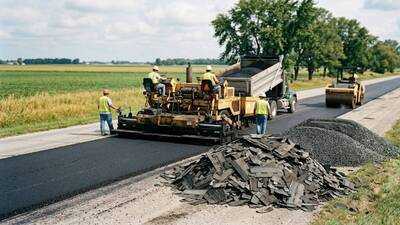
When a roof is redone, the old shingles are often taken to a landfill and dumped. US highway agencies have investigated recycling asphalt shingles in pavement for about 25 years, initially using manufacturing waste and later examining shingles removed from existing roofs. These tear-off shingles are harder to reuse because they come from different rooftops and have weathered for years in sun and rain. Engineers therefore needed field evidence to assess how they would perform in real traffic conditions.
Indiana began a 2009 to test how recycled shingles performed in asphalt pavement under real traffic conditions. INDOT’s technical brief says the mixes were planned and produced to meet state criteria. The lab tests seemed promising. But the narrative of the road was mixed over the next three years. Cracking occurred in all the test sections, greatest in the warm mix shingle part and least in a normal recycled asphalt mix. And that gives it a useful result precisely because it wasn't a clean win.
The trial itself
Contractor Phend & Brown completed the renovation in late summer 2009. Underneath was a layer of ancient concrete pavement with a layer of asphalt on top of it, which would be important later on in the story. Crews milled 1.5 inches (about 4 cm) of asphalt and replaced it with one of three pavement mixes. The first was a normal Indiana mix, 15% recycled asphalt pavement, with no shingles. The second, a normal hot mix, had 3% post-consumer shingles. The third used the same 3% shingles in a warm mix with foaming technology, which allows the binder to coat the stone at lower temperatures than hot mix.
The recycled shingles were ground finely enough to pass through a half-inch sieve. The shingles themselves contained 26.8% asphalt by weight; this figure describes the shingles’ composition, not their proportion in the pavement mix. The engineers had two questions: Would warm mix technology be detrimental to a shingle mix? How would a shingle recipe compare to the recycled pavement mix that Indiana previously used? Samples were obtained throughout manufacture and sent to the laboratory for testing, and those results dictated the way everyone read the road thereafter.
What the laboratory said
Indiana’s endeavour was just a part of a much wider effort. Iowa State University a national pooled fund study from 2009 to 2013, led by Missouri and including California, Colorado, Illinois, Indiana, Iowa, Minnesota, Wisconsin and the Federal Highway Administration. Each state took a different tack. Some looked at the grind of the shingles, some looked at how much to use, and Indiana looked at the combination with warm mix.
With shingles, the greatest effect was in the binder. Old shingle asphalt is substantially stiffer than fresh paving asphalt and will alter the performance grade of the blend. by one step to minus 16 degrees Celsius when 15% recycled asphalt pavement was added, while the high temperature grade remained at 70 degrees. The two mixes containing 3% recycled asphalt shingles had extracted binder graded PG 76-10, compared with PG 70-16 for the mix containing 15% recycled asphalt pavement. The shingle-containing mixes therefore had a higher high-temperature grade but a warmer low-temperature grade, indicating a potential trade-off in cold-weather performance. Foaming did not affect the grade. A firmer binder is more resistant to rutting in summer heat, but it performs less well in cold conditions.
The performance tests were more heartening. The flow number results showed that the shingle mixes would perform better than the recycled pavement mix for rutting resistance. Bending beam fatigue tests showed similar behaviour across the mixes, and a low-temperature cracking test showed no substantial difference in fracture energy across the three. A firmer binder is more resistant to rutting in summer heat, but it performs less well in cold conditions. But laboratory data could not capture heavy-vehicle traffic, so the road surveys were more important. 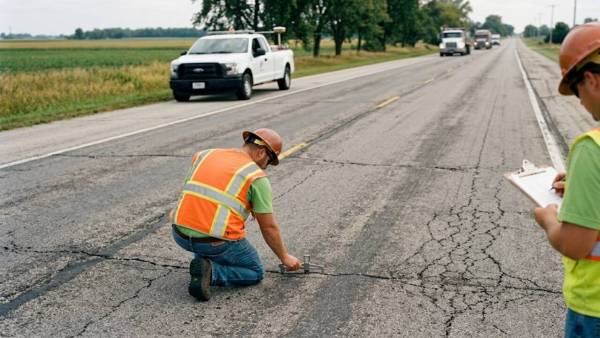
What the road showed
Engineers surveyed each portion one, two and three years after construction. By the end, all three parts exhibited transverse, longitudinal and fatigue cracking. In its brief, INDOT blames much of the transverse cracking on movement between the concrete slab and the asphalt overlay above it and says heavy truck traffic may be accelerating damage in the wheel tracks. The recycled pavement section, which did not contain shingles, had the least distress, while the warm-mix shingle section had the most. INDOT emphasised that the level of distress may be related to the state of the pavement under the overlay, which no test mix can correct.
The broader national study’s published in September 2013. Its summary of field performance after two years found no rutting, wheel-path fatigue cracking or thermal cracking across the demonstration projects, although transverse reflective cracking from underlying jointed concrete was recorded in several states, including Indiana. Indiana’s project appendix documents surveys through March 2012 and reports progression of transverse cracking, along with low-severity fatigue cracking, across the three test sections. The difference reflects the need to distinguish the national summary’s two-year findings from Indiana’s more detailed, three-year observations.
Even with warm mix technology, shingles may be blended into a mix that fulfils a state’s criteria, and INDOT found the results promising enough to share with other agencies creating their own rules. The trial showed that asphalt containing 3% recycled shingles could meet INDOT’s quality-assurance requirements. However, cracking developed across all three sections, and the lack of a pre-construction distress survey meant researchers could not conclusively attribute the damage to the shingles rather than movement in the existing pavement beneath the overlay.
Contact to : xlf550402@gmail.com
Copyright © boyuanhulian 2020 - 2023. All Right Reserved.