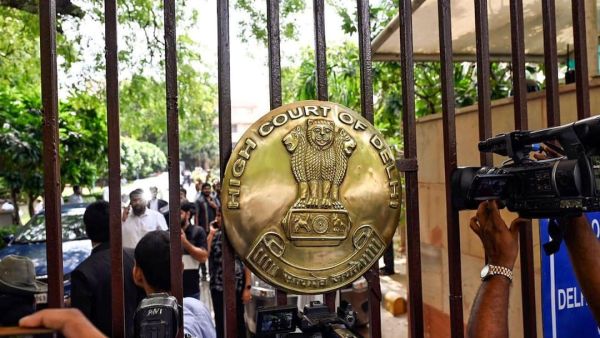
The Delhi High Court has rejected a review petition challenging the government’s decision to provide financial assistance instead of directly distributing school uniforms to students from economically weaker sections (EWS) and disadvantaged groups. The court said the policy could not be described as “completely arbitrary, whimsical or capricious”.
A bench comprising Justices Subramonium Prasad and Renu Bhatnagar dismissed the petition filed by the organisation Justice for All, finding no apparent error in its earlier ruling and no evidence that relevant material had been overlooked.
In its October 12 judgment, the court reiterated that judicial intervention in policy matters is generally limited to cases where a decision is so arbitrary, whimsical or capricious that it shocks the conscience of the court.
Why Did Justice For All Challenge The Uniform Assistance Policy?
The review petition challenged the High Court’s January 23, 2026, judgment, which modified its earlier directions concerning the implementation of the Right of Children to Free and Compulsory Education (RTE) Act, 2009.
The original petition sought enforcement of statutory provisions requiring recognised aided and unaided private schools in Delhi to provide free textbooks, uniforms and other study materials to students admitted under the EWS and disadvantaged group categories.
The dispute followed the Delhi government’s June 10, 2025, policy decision to offer financial assistance for uniforms rather than distribute the clothing directly.
Why Did The Delhi Government Opt For Cash Assistance?
The government had explained that purchasing and distributing uniforms involved a cumbersome process that could place an additional burden on the education department and schools.
It also pointed to the time required for procurement through the Government e-Marketplace, stating that the tendering process generally took around six months. In addition, uniforms differed across schools in design, colour and specifications.
After accepting the policy, the High Court modified its April 13, 2023, order in January 2026. It directed the government to ensure that eligible students received an adequate amount to purchase uniforms in accordance with the policy.
High Court Rejects Objection Over Review Proceedings
Justice for All argued that it had not been given an opportunity to file a reply and maintained that the government’s policy was inconsistent with the RTE Act.
The bench rejected the procedural objection, observing that the petitioner had been given adequate time after filing the review petition. Its counsel had appeared and argued the matter in full without requesting additional time to submit a reply.
The court, therefore, found no basis to conclude that the earlier proceedings had not been properly heard.
Court Says Review Cannot Replace An Appeal
The bench noted that the statutory provisions and the government’s policy had already been examined in the earlier judgment. It said the petitioner was attempting to raise the same arguments again.
The court clarified that review proceedings have a limited scope and cannot be used as an alternative to an appeal. A review may be considered if important, new evidence is discovered that could not have been produced earlier despite due diligence, or if an error is apparent on the face of the record.
The bench also observed that an alleged error requiring an elaborate process of reasoning to establish would not ordinarily qualify as an apparent error. It relied on Supreme Court judgments dealing with the scope of review jurisdiction.
Finding no apparent error in its earlier ruling and no failure to consider relevant material, the High Court dismissed the review petition along with the pending applications. Advocate Khagesh B Jha appeared on behalf of Justice for All.
(With ANI Inputs)
Contact to : xlf550402@gmail.com
Copyright © boyuanhulian 2020 - 2023. All Right Reserved.