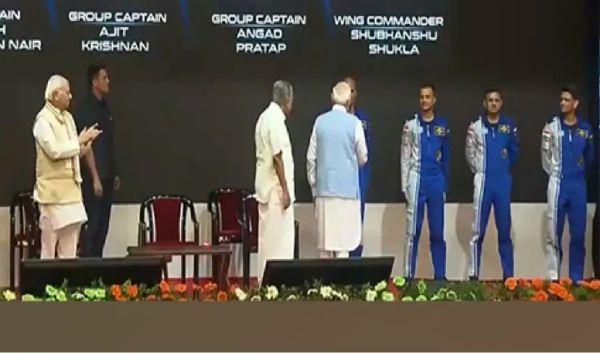
Possibility of new delay in Gaganyaan mission
India's ambitious human space flight programme, 'Gaganyaan', is expected to face yet another delay. Several senior officials of the Indian Space Research Organization (ISRO) said on condition of anonymity that now its first unmanned mission will not be launched before February 2027. It was initially planned to launch in December 2026, but it may be further delayed due to technical improvements and additional simulation processes. Human Space Flight Center (HSFC) and U.R. Officials aware of the ongoing activities at the Rao Satellite Center (URSC) said about 80 per cent of the work has been completed, but some important work still remains before the spacecraft and launch vehicle are cleared for flight. A senior official said that ISRO wants to make this mission completely safe and error-free. This will be India's first demonstration of human spaceflight capabilities, and when such big technology is involved, there are bound to be uncertainties.
Mission preparation and testing
Rocket and Test: The mission will be launched from a human-rated HLMV-3 rocket, an upgraded version of the Chandrayaan-3 rocket. 'Thermo-vac' testing of the entire module is currently underway, in which the equipment is being tested in space-like vacuum conditions.
Return process: The rocket will deliver both modules to low Earth orbit. After testing, the crew module will separate from the service module and return to the atmosphere. The heat shield will protect it from excessive heat and reduce parachute movement. Ultimately, it will land in the ocean.
Manned mission: After the success of the first two stages, the third flight will send two or three Indian astronauts, which will spend three days at an altitude of 400 km. Crew escape system is ready for this.
Change in timeline of Gaganyaan
The development comes months after ISRO Chairman Dr V Narayanan indicated that the first uncrewed 'Gaganyaan' mission would be included in the agency's planned launch plans for 2026. After the successful launch of GSLV-F17 carrying EOS-05 in September, Narayanan said six more launches are planned this calendar year, including NVS-03 and the first unmanned flight of Gaganyaan. Emphasizing the complexity of this mission, he said that about 8,000 tests have been completed so far.
Gaganyaan was originally approved in January 2019, with the aim of launching India's first manned space flight by May 2022. However, the COVID-19 pandemic disrupted hardware production and supply chains, forcing ISRO to rethink its timeline.
Important tests and future plans
The first uncrewed flight, G1, will carry ISRO's half-humanoid robot 'Vyommitra'. Its purpose is to test critical systems of the spacecraft before astronauts launch. This mission will test the 'human-rated' LVM3 launch vehicle, crew module, life support technologies and recovery systems. Since human life will depend on these systems in the future, ISRO is giving more importance to their reliability rather than the launch deadline. If the latest assessment proves correct, India's first major step towards sending astronauts to space on its own could be taken in February 2027.
Contact to : xlf550402@gmail.com
Copyright © boyuanhulian 2020 - 2023. All Right Reserved.