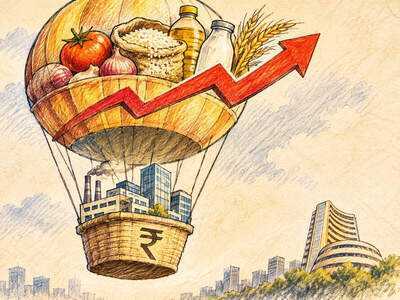
Indian companies are expected to maintain healthy revenue growth of 18-20% in the December quarter, although rising , higher borrowing rates and weakening rural demand could squeeze profit margins, according to rating agency .
The forecast marks a moderation from the 24.2% year-on-year revenue growth recorded in the September quarter, as companies increasingly rely on price increases to support sales while demand growth shows signs of slowing.
In a report released on Thursday, ICRA said operating profit margins of Indian companies could decline by 50-75 basis points year-on-year during the third quarter of FY27, reflecting continued pressure from elevated energy, freight, packaging and labour costs.
The assessment covers 3,103 listed companies, excluding those in the financial sector. Despite the expected margin compression, the rating agency expects corporate balance sheets to remain relatively resilient, with interest coverage ratios projected at 5-5.2 times during the quarter, compared with 5.7 times in Q2.
Why sales growth may slow
The September quarter benefited from a combination of higher product prices and strong demand, particularly in the automobile sector.
Passenger vehicles, two-wheelers and commercial vehicles recorded healthy volume growth, supported by sustained demand following the reduction in Goods and Services Tax (GST) rates in September 2025. However, the benefits of those tax cuts also created a higher comparison base for the December quarter.
ICRA expects volume growth to moderate as companies pass on increases in raw material, energy, labour and logistics costs to consumers.
The rating agency said inflationary pressures stemming from the West Asia conflict could continue to influence corporate pricing decisions. Nevertheless, strong festive and wedding-season spending, higher product realisations and healthy government capital expenditure are expected to support revenues.
Some major festivals shifting into the December quarter could also provide a boost to consumer-facing businesses.
Automobiles and retail may outperform
ICRA expects domestic-focused sectors such as automobiles, retail, consumer durables and hospitality to outperform export-dependent industries during the coming quarter. "We expect the divergence between domestic-oriented and export-oriented sectors to persist in the near term," said Kinjal Shah, Senior Vice President and Co-Group Head, Corporate Ratings, ICRA.
She said information technology and cut-and-polished diamond exporters could continue to face difficulties because of subdued global demand and economic uncertainty.
However, an easing of US tariffs could provide some support to apparel and home textile exporters, although renewed trade uncertainty remains a risk.
The rating agency also warned that an uneven monsoon and crop losses associated with El Nino could weaken agricultural incomes and rural consumption. "The subpar and spatially uneven monsoon is likely to result in unfavourable agricultural outcomes, with potential negative implications for farm incomes, rural consumption and food inflation," Shah said.
These factors could weigh on rural-focused businesses and agriculture-linked sectors over the next two to three quarters.
Profit margins face fresh pressure
While companies have increased prices to offset rising costs, ICRA expects the benefits of these measures to emerge gradually. Sectors including aviation, automobiles, fast-moving consumer goods, cement and other energy-intensive businesses remain vulnerable to higher crude oil prices and their derivatives, palm oil, coal and logistics expenses.
The depreciation of the rupee against the US dollar has also increased the cost of imported inputs for some businesses.
"Price revisions undertaken across sectors such as automobiles, FMCG, retail, chemicals and aviation to offset elevated input, energy, freight and logistics costs are likely to translate into a healthy price-led revenue growth and partially mitigate the impact of inflation on margins," Shah said.
"However, margins are expected to remain under pressure, particularly in the price-sensitive segments as the ability to fully pass on higher costs remains constrained because of intense competition and demand considerations," she added.
ICRA noted that the oil and gas sector had benefited from stronger refining margins, particularly improved diesel crack spreads, and a sequential recovery in marketing margins during the September quarter.
These gains helped support the overall profitability of Indian companies. However, future earnings in the sector will remain sensitive to movements in crude oil prices and refining spreads.
Metals and mining companies, upstream oil producers, telecom operators, hospitality businesses and regulated utilities are relatively better positioned to protect profitability because of favourable realisations, pricing flexibility or mechanisms that allow costs to be passed on to customers.
Recent declines in crude oil and palm oil prices, along with an improvement in the rupee, could provide some relief, although ICRA said it remains uncertain whether these trends will continue.
Disclosure: This article has been written by Podishetti Akash, who is not a SEBI-registered Research Analyst or an Investment Adviser. Podishetti Akash and his ‘relative(s)’ (as defined under Section 2(77) of the Companies Act, 2013) do not hold any financial interest in the companies mentioned in this article as of the date of publication. The views/recommendations mentioned in this article, wherever applicable, are those of the respective SEBI-registered Research Analyst/brokerage and have been reproduced/reported with due attribution. They should not be construed as the views or recommendations of The Economic Times Digital or the journalist. Readers are advised to consider the original research report and make their investment decisions based on their own assessment. Brokerage disclosures .
Contact to : xlf550402@gmail.com
Copyright © boyuanhulian 2020 - 2023. All Right Reserved.